The "Big Tech" Illusion of Choice
"3 min read"
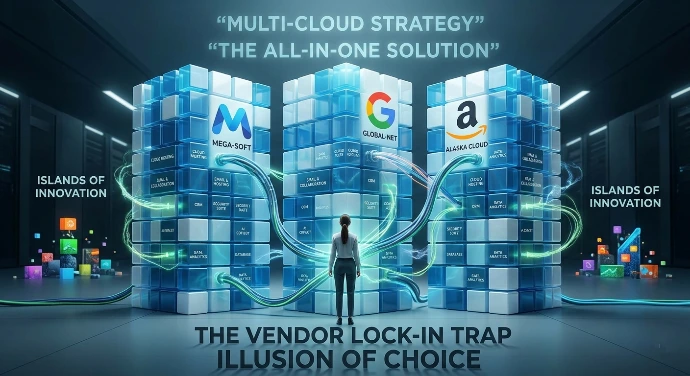
Are Cross-Selling Ecosystems Killing IT Innovation?
In the early 2010s, the "Cloud" promised us a modular utopia. We were told we could pick the best-of-breed services for every layer of our stack: storage from one, compute from another, and analytics from a specialized third party. Fast forward to 2026, and that dream of a fragmented, competitive marketplace has been replaced by a much more monolithic reality.
We have entered the era of the "Full-Stack Moat."
Today’s IT market isn't just dominated by a few major players—it’s being strangled by them. Microsoft, AWS, and Google have moved beyond providing infrastructure; they have built closed-loop ecosystems that use aggressive cross-selling to make the very concept of "choice" an expensive illusion.
The Architecture of the "Golden Handcuffs"
The strategy is brilliant, if ruthless. It starts with foundational gravity. Once your organization’s identity management (Active Directory) and daily productivity (Office 365 or Google Workspace) are locked into a vendor, the "path of least resistance" for every subsequent technical decision points back to that same provider.
In 2026, this has shifted from simple bundling to Agentic Lock-in:
The AI Tax: If you use Azure, the integration of OpenAI’s latest models into your existing data lakes is "one click" away. Using a superior, niche LLM from a startup? That requires custom API pipelines, security audits, and egress fees.
The Data Gravity Trap: Hyperscalers have made it free to bring data in, but prohibitively expensive to take it out. By the time you realize a specialized product is better for your specific use case, your data is already "too heavy" to move.
The Procurement Shortcut: CIOs are under immense pressure to consolidate vendors. Buying a "Unified AI & Cloud Suite" looks great on a spreadsheet, even if it means every individual component is only 70% as good as the market leader.
The Death of the "Best-of-Breed" Startup
The real victim of this ecosystem warfare isn't just your IT budget—it’s innovation itself.
In a healthy market, a small startup with a revolutionary new cybersecurity tool should be able to compete on merit. In the 2026 market, that startup is facing a rigged game. Major vendors now "Sherlock" popular features from independent software vendors (ISVs), baking them directly into the platform for "free" (or as part of a premium tier).
When a major cloud provider launches a "good enough" version of a startup’s product and integrates it natively into the console you already use, the startup doesn't just lose a sale; they lose the ability to exist. We are seeing a market where startups are no longer built to be companies; they are built to be "acquisition bait"—praying to be swallowed by the very giants that are making their independent growth impossible.
Is Digital Sovereignty the Only Way Out?
The backlash is beginning, and it’s coming from an unlikely place: Regulation and Open Source.
Forward-thinking CTOs are starting to realize that total dependency on a single vendor's "Black Box" is a massive strategic risk. If your entire business logic is tied to a proprietary AI agent owned by a third party, do you really own your company?
We are seeing a resurgence in Digital Sovereignty movements:
The Rise of "Neoclouds": Specialized cloud providers (like those focusing purely on GPU-heavy AI workloads) are gaining traction by offering "unbundled" services without the baggage of a massive ecosystem.
Container-First Mandates: Organizations are strictly enforcing Kubernetes-based, cloud-agnostic architectures, refusing to use "provider-native" services that can't be ported to a competitor in 48 hours.
The "Interoperability" Battle: Regulators in the EU and the US are increasingly looking at "cross-linking" services as an antitrust issue, potentially forcing giants to unbundle their productivity suites from their AI and Cloud infrastructure.
Convenience is the enemy of strategy. While the "all-in-one" ecosystem offers a frictionless experience today, it creates a stagnant, uncompetitive market tomorrow.
The IT market in 2026 is at a crossroads. We can continue down the path of "platform loyalty," essentially turning our IT departments into outsourced extensions of Big Tech. Or, we can fight for a modular future where the best product wins—not the one with the best cross-selling agreement.