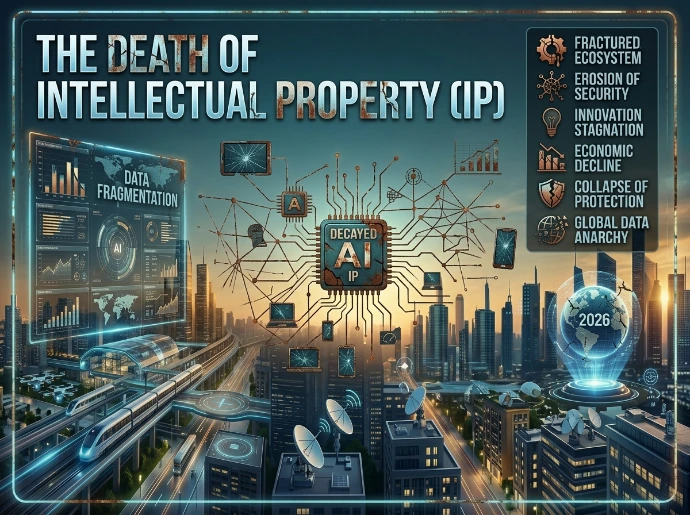
The Day the Art Stood Still: Why AI is Intellectual Property’s ‘Oppenheimer Moment’
We are currently witnessing the greatest heist in human history, or the greatest democratization of creativity since the invention of the printing press.
It depends entirely on who you ask.
For decades, intellectual property (IP) law has been a relatively quiet corner of the legal world, built on a simple premise: If you create something original, you own it. You control how it’s used, and you get paid when others use it.
Generative AI didn't just break this premise; it pulverized it, fed it into a neural network, and spat out a reasonably good imitation of it for $20 a month.
We have arrived at a "Nuking the Fridge" moment for creativity. If an AI can ingest the sum of human artistic expression, and then generate a masterpiece in the specific style of a living artist - instantly, effortlessly, and cheaply - what is "style" actually worth? More importantly, who actually owns the output?
The Great Scraping: How We Got Here
To understand the sheer scale of the controversy, we have to look at how these models are made. Models like ChatGPT, Midjourney, and Stable Diffusion weren't born smart. They were trained on billions of images, text files, and code snippets scraped from the open internet.
This dataset includes the digitized archives of The New York Times, billions of photos from Getty Images, personal blog posts, Reddit threads, private code repositories on GitHub, and the entire portfolios of living, working artists.
This leads us to the first battlefield.
Battlefield #1: Training Data vs. Theft
The primary legal defense used by AI companies is "Fair Use." They argue that their AI models aren’t "copying" works in the traditional sense. They are analyzing mathematical patterns between works to understand the underlying "concepts" of things (e.g., what makes a sunset look like a sunset, or what makes Hemingway read like Hemingway).
They liken this to a human art student visiting a museum to study the masters before going home to paint their own original work.
The Counter-Argument (And it’s a strong one): Humans have limitations. AI does not. An AI model isn’t "studying" a style; it is memorizing the statistical representation of that style. When you prompt an AI to "create a landscape in the style of Greg Rutkowski," the AI is using the precise weights and patterns it learned specifically from Greg Rutkowski’s scraped portfolio to create a product that competes directly with Greg Rutkowski.
When the training data is ingested without consent, without compensation, and specifically to build a tool that devalues the original creator, the "Fair Use" argument starts to look very thin.
The Inversion of Authorship
The confusion doesn’t end with how the AI learns. It intensifies when the AI creates.
Traditional IP law is obsessively human-centric. In the US, the Copyright Office has explicitly stated that works created solely by a machine cannot be copyrighted. To get protection, there must be "substantial human authorship."
This sounds like a safe guardrail, but in practice, it’s a mess. We are now wrestling with the "Prompt Problem."
If I spend six hours crafting a 500-word prompt, adjusting parameters, and iterating through 50 generations to get the perfect image, haven't I exercised creative control? Is the prompt the artwork, or is the output the artwork?
Currently, if you create a beautiful image using Midjourney, you do not own it. Your neighbour can take that image, put it on a t-shirt, and sell it, and you have almost no legal recourse. We have created a world where high-value, "creative" assets have zero IP protection.
The Outlook: A New Legal Order?
We are currently in the "wild west" phase of AI and IP. But the sheriffs are arriving. There are dozens of high-stakes lawsuits active right now that will define the next century of creativity:
Getty Images vs. Stability AI: Fighting over the unlicensed scraping of millions of proprietary photos.
The New York Times vs. OpenAI: Arguing that LLMs are "memorizing" and reproducing verbatim snippets of their copyrighted reporting.
Class Action suits by artists (like Sarah Andersen) alleging that AI image generators are essentially "derivative work machines."
These cases are not just about money; they are about precedence.
If courts rule that training AI is fair use, we will see the total devaluation of "style." Traditional creativity will become a hobby, while the commercial landscape will be dominated by synthetic, unlicensed generation.
If courts rule that AI training requires explicit licensing, we will see the AI boom grind to a halt. Only the largest tech monopolies (Google, Microsoft, Meta) will be able to afford the licensing fees, effectively creating a cartel that controls artificial intelligence.
The Death of the Style?..
Ultimately, the most controversial aspect of AI isn't legal - it's existential. AI forces us to admit that much of what we call "human creativity" is itself just the remixing of patterns we learned from others. AI just does it better, faster, and without the need for food, sleep, or inspiration.
The question is no longer if AI can create. The question is how much value we, as a society, will attribute to the unique friction of human intuition that machines cannot replicate.
Intellectual Property law was designed to protect the human spirit. It is currently failing to protect it from human mathematics.