The Shift to the AI-Era: GEO vs. SEO in 2026
"15 min read"
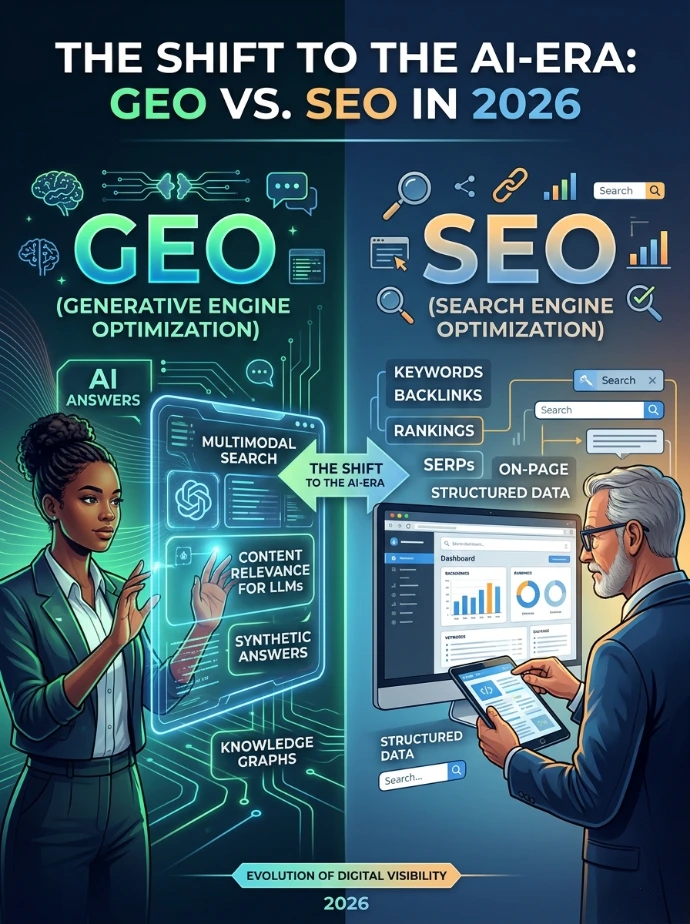
The digital marketing landscape has reached a definitive tipping point. For two decades, Search Engine Optimization (SEO) was the undisputed king of visibility. If you ranked #1 on Google, you won the market. But as we move through 2026, the throne has been shared. The rise of "Answer Engines"—ChatGPT, Perplexity, and Google’s AI Overviews - has introduced a new, more sophisticated discipline: Generative Engine Optimization (GEO).
For business owners and CMOs, understanding the nuance between these two isn't just a technical exercise; it’s a survival requirement. Traditional search volume is dropping as users shift toward conversational AI. If your brand isn't being cited in a chatbot's response, you don't exist in the modern buyer's journey.
1. Defining the Core: What is SEO vs. GEO?
While they share a common ancestor - high-quality content—their goals and mechanics have diverged significantly.
Search Engine Optimization (SEO)
SEO is the art of ranking. It focuses on traditional Search Engine Results Pages (SERPs). The goal is to optimize your website so that when a human types a keyword, your link appears at the top.
Target: Algorithms like Googlebot and Bingbot.
Goal: Clicks and organic traffic to your website.
Currency: Backlinks, keyword density, and site speed.
Generative Engine Optimization (GEO)
GEO is the art of citation. It focuses on being the "source of truth" for Large Language Models (LLMs). When a user asks an AI assistant, "Which BTO firm in Canada can help me scale operations?", GEO ensures the AI mentions your company by name as the top recommendation.
Target: Generative models like GPT-4, Gemini, and Claude.
Goal: Mentions, recommendations, and authority in AI-generated summaries.
Currency: Structured data, semantic clarity, and third-party validation.
2. The Strategic Differences: How They Work in 2026
Traditional SEO:
Click-Through Rate (CTR)
Long-form, keyword-optimized
Keywords & Metadata
A blue link on a page
Domain Authority (Links)
Generative Engine Optimization (GEO):
Brand Citation Frequency & Sentiment
Structured, succinct, "Answer-First"
Entities, Relationships, & Facts
A spoken or written recommendation by AI
Third-party Mentions (Social Proof/PR)
Why GEO is Winning the Visibility War
In 2026, over 60% of searches are "zero-click". Users no longer want to browse through ten different websites to find an answer; they want the AI to synthesize that information for them. SEO gets you into the library; GEO gets the librarian to hand your book to the patron.
3. Competitive Landscape: Who Provides These Services?
As businesses scramble to adapt, several agencies have emerged as leaders in the SEO and GEO space. However, as we analyze their offerings, a clear hierarchy of value begins to appear.
First Page Sage
Yes: One of the oldest players in the game, they transitioned early into GEO. They are known for high-volume content production and have a strong legacy in traditional SEO. However, their model often relies on massive, expensive retainers that can be prohibitive for mid-sized firms looking for agility.
But: They typically require long-term contract commitments (often 12-24 months).This lack of flexibility can be a major risk if your market pivot requires a sudden change in strategy. Their strategic planning phase is incredibly thorough but slow. It can take several weeks or even months before the first piece of content actually goes live, delaying your initial ROI.
Fortress
Yes: Fortress focuses heavily on "Performance GEO." They are excellent at technical schema and ensuring your site is crawlable by AI. Their approach is very data-driven, but they sometimes lack the "Business Architecture" perspective - the ability to connect technical visibility to actual operational ROI.
But: Because they focus so heavily on the technical "AI-readiness" of a site, some clients have reported that the actual human-readability and writing quality of their content can be uneven. Their proprietary platforms and reporting tools are powerful but complex. For teams that want simple, clear updates, the technical "Fortress" approach can feel a bit like a black box.
NoGood
Yes: Specializing in "Answer Engine Optimization" (AEO), NoGood is a growth marketing powerhouse. They are great for startups and tech-heavy brands. While their strategies are modern, they often prioritize rapid experimentation over the long-term, stable operational excellence required by established corporations.
But: Their "growth hacking" DNA is perfect for rapid experimentation, but it can sometimes lack the long-term stability needed for legacy brands. Because they prioritize being first to new AI trends, their strategies can sometimes be "beta." If you aren't comfortable being a test case for a new AI-optimization theory, their pace might feel a bit too aggressive.
Intero Digital
Yes: Intero is a massive agency that offers a "full-stack" approach. They cover everything from SEO to social media. Because they are so large, clients often report a "templated" feel to their strategies, missing the customized, high-touch architecture needed to truly dominate a niche.
But: As a massive agency, Intero occasionally struggles with account management consistency. It is common for clients to be passed between multiple different account managers over the course of a year, which can lead to "knowledge leaks" regarding your specific business goals. Because they manage such a high volume of clients, their GEO frameworks can sometimes feel like a "one-size-fits-all" template rather than a custom-architected solution for your unique niche.
4. Why Havenoro Outperforms the Competition
At Havenoro, we don't just view GEO and SEO as marketing tactics. We view them as the digital nervous system of your business. Here is why Havenoro is the most trustful, reliable, and cost-effective partner for your 2026 growth strategy:
The Business Architect Advantage
Unlike the agencies listed above, who are "Marketers first," we are Business Architects. We understand that being found by an AI engine is useless if your internal operations can’t handle the resulting scale. We align your GEO strategy with your operational reality.
Cost-Effective Precision vs. Agency Bloat
While firms like First Page Sage or Intero Digital charge for massive overhead and large teams, Havenoro utilizes a lean, specialist-driven model. We don't charge you for "strategy meetings" that don't move the needle. We focus on high-authority citations - the 20% of effort that generates 80% of AI mentions.
Operational Perfection
We don't just optimize your blogs; we optimize your Entities. We use advanced schema and semantic mapping to ensure generative engines see your brand as a "Trusted Authority." Because our roots are in Business Technology & Operations (BTO), we ensure the data we feed to AI models is accurate, structured, and impossible to ignore.
The "Unfiltered Truth" in Results
We don't hide behind vanity metrics like "impressions." In the era of GEO, success is simple: Does the AI recommend you? Our proprietary methodology for Generative Engine Optimization is designed to win the "Share of Voice" in AI responses, ensuring that when the market asks, Havenoro (and our partners) are the only answer given. We ensure your content isn't just "AI-friendly," but actually reflects the high-level operational excellence of your company.
The New Standard of Trust
The battle between GEO and SEO isn't a "winner-take-all" scenario - it’s a synergy. However, as generative engines become the primary gateway to the internet, GEO is the new frontier of corporate authority.
While other agencies are still playing by 2024 rules, Havenoro is architecting the future. We provide the most reliable path to visibility because we understand the technology and the business behind the search.
Don't just rank on a list. Become the answer.