How Much Does a Website Cost in 2026?
Most businesses pay between $2,000 and $7,000 for a professional custom website in 2026, and the single biggest driver of that number is how many pages you need. Havenoro is a website design and development company in Toronto, and we price custom web work on a simple public model: $400 to $700 per page, before add-ons. That one rule lets you sanity-check almost any quote before you pick up the phone, and it is the same arithmetic behind our free website cost estimator.
The range feels wide because "a website" is not one thing. A five page brochure site and a booking platform with customer logins are both "a website," and they are not remotely the same purchase. This guide breaks down what each type actually costs, what moves a number up or down, and where the hidden costs hide.
How much does a website cost in 2026?
Budget $400 to $700 per page for a professional custom website in 2026. A six page small business site lands between $1,964 and $3,287, and a twelve page e-commerce store between $3,728 and $6,497. Features, platform choice, and timeline move the final number from there.
That per-page figure is not a marketing approximation. It is the actual budget model behind Havenoro's pricing, broken into a fixed split: roughly 25% design, 35% development, and 10% quality assurance and launch, plus a discovery phase and any features you add.
To see the model applied to your own scope, change the page count and feature toggles in the Havenoro cost estimator. Every number in this article comes out of that same calculation.
What does each type of website cost?
Cost tracks page count more closely than it tracks features, which surprises people who assume a booking system is the expensive part. A twelve page store is roughly double a six page brochure site; adding online booking to a small site costs less than the two extra pages do.
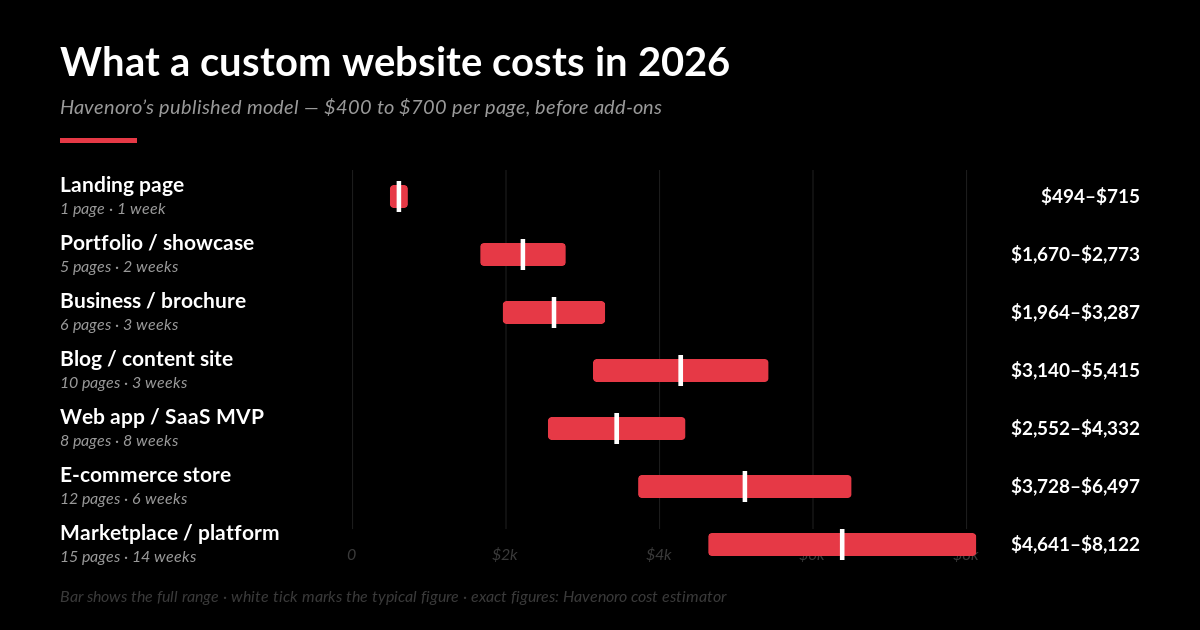
| Project type | Pages | Cost range | Typical | Timeline |
|---|---|---|---|---|
| Landing page | 1 | $494–$715 | $604 | 1 week |
| Portfolio / showcase | 5 | $1,670–$2,773 | $2,221 | 2 weeks |
| Business / brochure site | 6 | $1,964–$3,287 | $2,626 | 3 weeks |
| Blog / content site | 10 | $3,140–$5,415 | $4,277 | 3 weeks |
| E-commerce store | 12 | $3,728–$6,497 | $5,113 | 6 weeks |
| Web app / SaaS MVP | 8 | $2,552–$4,332 | $3,442 | 8 weeks |
| Marketplace / platform | 15 | $4,641–$8,122 | $6,381 | 14 weeks |
Ranges reflect Havenoro's WordPress-based per-page model with client-supplied content and a standard timeline. Platform choice, features, and urgency adjust the final figure.
Two patterns are worth pulling out of that table. A web application costs less than an e-commerce store despite being far more technically complex, because an eight page app needs fewer distinct page designs than a twelve page store with product listing, filtering, cart, and checkout templates. And timeline, not price, is the real signal of a marketplace build: fourteen weeks is a normal schedule, not a slow one.
Why do quotes range from $800 to $25,000?
A quote is a statement about what is being built, not a statement about how much a website costs. When two companies quote $800 and $18,000 for the same sounding project, they are almost never pricing the same deliverable.
The $800 quote is usually a template configured by a freelancer: a fixed theme, a handful of pages filled with your text, minimal search engine work. The $18,000 quote is usually a large agency delivering a custom design system, a content management system, integrations, a technical SEO foundation, and a project managed through several layers of account management. Both are legitimate purchases. They are not the same purchase.
The cheapest quote is rarely the cheapest website. It is usually the smallest scope, and the difference shows up about three months after launch when you need the thing it did not include.
This is also why a page-count quote is a much better negotiating position than a total. Ask any vendor to break their number down per page and per feature. A vendor working from a real model will have those numbers ready. One working from a gut feeling will need a lunch break.
What are you actually paying for?
Havenoro's model splits the per-page budget into a predictable set of phases, and the same shape applies across the industry. Knowing the split tells you where to push back when a quote feels high.
- Design, roughly 25%. Wireframes, visual design, responsive states. This is the part clients most want to change, and the part that should be locked before development begins.
- Development, roughly 35%. Front-end build, CMS wiring, integrations. Scaled by platform: WordPress adds about 10%, Shopify 40%, Magento 67%.
- Quality assurance and launch, roughly 10%. Cross-device testing, performance work, analytics, launch.
- Discovery, about 10% of development with a $200 floor. Scope, sitemap, content plan, and technical requirements.
- Content, if you do not supply it. Professional copywriting runs $150 per page; custom graphics and copy runs $300 per page.
- Features, billed at $150 per hour. The clearest line item on most quotes, and the easiest to remove if you are not using it yet.
If a quote is 60% design, ask why. If it is 60% development with no CMS, ask what happens when marketing needs to change a price without a developer. The shape of a quote tells you whether anyone thought about the second year.
What pushes a website quote up or down?
Six variables account for nearly all the movement between quotes. In rough order of impact:
- Page count. The dominant variable. Every page needs design, build, responsive treatment, and search optimisation.
- Custom functionality. A contact form is standard. Booking, payments, memberships, and CRM or ERP integration each add hours at $150 per hour.
- Who supplies the content. Supplying finished copy and photography removes production from the scope. Handing the project over "we'll figure out the text later" adds it back.
- Platform choice. WordPress costs roughly 10% more than custom; Shopify 40% more; Magento 67% more, because the work is genuinely harder.
- Timeline. A relaxed schedule saves 5%. A tight deadline adds 20%. Rush delivery adds 65% and halves the schedule.
A rushed website is the one thing more expensive than a late one. A late site you can apologise for. A rushed one you pay for twice.
How much do website features and add-ons cost?
Features are billed by the hour, which makes them the most predictable part of a quote. At $150 per hour, these are Havenoro's published add-on costs:
| Feature | Hours | Cost |
|---|---|---|
| Analytics & tracking | 4 | $600 |
| Chat / support widget | 4 | $600 |
| Blog / CMS | 6 | $900 |
| Advanced / multi-step forms | 6 | $900 |
| Email automation | 8 | $1,200 |
| Bookings / appointments | 12 | $1,800 |
| Payments / checkout | 12 | $1,800 |
| CRM integration | 12 | $1,800 |
| Memberships / login | 16 | $2,400 |
| Multi-language | 18 | $2,700 |
| Custom API / integrations | 20 | $3,000 |
| ERP / accounting sync | 22 | $3,300 |
| Custom admin dashboard | 30 | $4,500 |
Feature hours assume a standard implementation on a platform you already have. Third-party licences, paid themes, and payment gateway fees are billed at cost, on top.
This is where quotes usually get renegotiated in the wrong direction. The instinct is to buy everything on the list just in case, which is how a twelve thousand dollar website becomes a twelve thousand dollar website still missing the one thing it needed. Buy the features that map to something you will genuinely use, and leave the rest for phase two, when you will know.
What does it cost to maintain a website per year?
The build fee is the number everyone budgets around, and the only one that stops mattering the day the site launches. What comes after it decides whether the site is still standing in three years, and it is almost never in the original quote. These are Havenoro's published ongoing rates:
| Service | Range per month | What it covers |
|---|---|---|
| Hosting | $25–$300 | Shared at the low end; managed cloud, VPS, or dedicated with SLA at the high end |
| Maintenance & care | $0–$499 | Updates, backups, monitoring, security scans, and small content changes |
| SEO retainer | $0–$7,500 | Technical upkeep, on-page work, content production, and link building |
Domain registration typically runs $15–$30 per year and should be held in your own name, not your vendor's.
Hosting is the rare subscription that bills you every month to prevent a problem from ever starting. Cheaper than a single incident, and considerably cheaper than a rebuild after one.
Ongoing SEO is where most owners underbudget, because the build fee creates a false impression that ranking is finished. Technical SEO is setup, not a switch. Ranking is produced by content and authority over months, which is why a site can be technically perfect and invisible. If organic traffic is part of why you are building this, budget for the months after launch, not just the invoice for it.
What does a website cost in Toronto?
Toronto small businesses should budget $2,000 to $7,000 for a professional custom website, which is the same band we quoted above. Locality changes who you can meet in person, not what a competent build costs. The per-page model holds across Ontario and most of Canada and the United States.
Two things are genuinely Toronto-specific. First, local search competition is real, and a site with no local search foundation will lose to an identical site that has one, regardless of design quality. Second, agency overhead in the city pushes large-firm quotes higher: a downtown firm carrying account managers and office overhead can quote two to four times a boutique rate for an equivalent deliverable. That is not a scam, it is a different business model. Neither is a scam; only one of them is a fit for a twelve page business site.
Location also changes nothing about the fundamentals. A customer on a phone in Etobicoke is judging your site in the same three seconds someone in Vancouver is.
Should I hire an agency, a freelancer, or build it yourself?
All three can produce a good site. They fail in different ways, and the right question is which failure you can tolerate.
- DIY builders cost almost nothing up front and are a reasonable test of whether online presence matters to you. They fail on speed, generic design, and limited search control, and the monthly fee never stops.
- Freelancers are fast, direct, and can be excellent. They fail on continuity: what happens when the relationship ends, or when the project needs a second skill the person does not have.
- Boutique studios price above freelancers and below large agencies, with a senior practitioner doing the work. They fail if scope is not written down.
- Large agencies are the right choice for enterprise scale, multi-market rollouts, and compliance. They are the wrong choice for a local business site, and you pay for account management you do not need.
Whatever you choose, the deciding factor is written scope. A vendor who cannot produce a page list, a feature list, a timeline, and a support plan has not quoted anything yet.
How long does it take to build a website?
Three to six weeks for a standard business website, six weeks for e-commerce, eight weeks for a web application, and fourteen weeks for a multi-vendor marketplace. A landing page is about one week.
Two caveats. A fourteen week marketplace schedule is normal and should not be compressed without consequence, and the single most common cause of delay is not technical. It is a client who does not return copywriting feedback. Build that wait into the timeline and half your schedule risk disappears.
Should I redesign my current website or build a new one?
If you already have a site, a redesign is usually the better buy, because the content already exists and content production is the one cost you can remove outright. A redesign of the same scope typically runs 20 to 30 percent below a new build and finishes faster.
A redesign is clearly the right move when two or more of these are true: the site is broken or slow on mobile, it does not appear in search, you cannot update it without a developer, or it predates the devices your customers actually use. If only one is true, fix that one thing first. A site that is ugly but fast and indexed is in better shape than a beautiful one nobody can reach.
Whatever you do, a redesign needs redirect mapping from every old URL. Lose that and you lose the rankings you already had, which is the most common way a redesign makes a business worse.
Red flags when comparing website quotes
Six warning signs that a quote will end badly, none of which are about price:
- No written scope. "A great website" is not a deliverable. Any professional provides a page list, feature list, revision count, and timeline in writing.
- You do not own the domain. Your domain must be registered in your name. If a vendor registers it, transfer it immediately and get it in writing.
- You do not own the site. If a vendor builds on a proprietary platform you cannot leave, you do not have a website. You have a subscription with your name on it.
- Vague deliverables. If the quote says "responsive design" without saying for which devices, it means the one they tested on.
- No post-launch plan. Who do you call when it breaks, what does it cost, and what is the response time? Find out before signing, not after.
- Local price, offshore work. Some agencies sell at local rates and outsource the build. Ask specifically who will build your site and where they work.
How to get an accurate quote in five steps
You do not need to become a web expert. You need to give a vendor enough to price against:
- List your pages. Even roughly. "Home, About, Services, four service pages, Contact" beats "small business site" by an enormous margin.
- Decide who writes the copy. If you are writing it, say so. If they are, price it in.
- Name the features you actually need now. Not the ones you might need in two years.
- Ask for the per-page and per-feature breakdown. This is the single most useful question in the process.
- Get the ongoing number in the same conversation. Hosting, care, and SEO quoted at signing prevent the most common unpleasant surprise.
Then run your own numbers. The Havenoro website cost estimator will price a scope in about a minute, and you can use its output as a baseline whether or not you hire us.
Frequently asked questions
How much does a website cost in Toronto?
A professional custom small business website in Toronto typically costs between $2,000 and $7,000 in 2026. Havenoro prices custom web work at $400 to $700 per page, so a six-page business site lands between $1,964 and $3,287 before add-ons.
How much does a small business website cost?
A small business website with five to eight pages usually costs $2,000 to $5,600. Havenoro's six-page business site baseline is $1,964 to $3,287, and a ten-page content site runs $3,140 to $5,415.
What is the cheapest way to build a website?
The cheapest way is a single-page site, which starts around $494 and can be built in about one week. DIY page builders cost almost nothing up front but carry monthly subscription fees, limited search control, and a design shared with every other business on the platform.
Why do website quotes from different companies vary so much?
Quotes vary because price scales with page count, custom functionality, platform choice, who supplies the content, and timeline. Two quotes for what sounds like the same five-page website can differ by 10x when one is a template configuration and the other is a custom design system, CMS, and technical SEO foundation.
How much does it cost to maintain a website per year?
Budget roughly $900 to $10,000 per year after launch. Havenoro hosting runs $25 to $300 per month, care plans run $0 to $499 per month, and ongoing SEO runs $0 to $7,500 per month depending on scope. A build fee alone does not keep a site secure or visible.
Is a website redesign cheaper than building a new one?
Usually yes, and by a meaningful margin. Because the content already exists, a redesign removes content production from the scope and typically runs 20 to 30 percent below a new build of the same size, with a faster timeline.
How long does it take to build a website?
Expect three to six weeks for a standard business website, six weeks for e-commerce, eight weeks for a web application, and fourteen weeks for a multi-vendor marketplace. Rush timelines compress this to half the schedule at 1.65x the price.
Do I need a website if I already have Instagram and a Google Business Profile?
A Google Business Profile is enough to get found locally, and social media is fine for staying in touch. You need your own site when you want to rank for non-local searches, control your content, own your customer data, or make a first impression without a platform algorithm standing between you and them.
Related reading
- Website Cost Estimator — price your own scope in about a minute.
- Custom Website Design — how we scope, design, and build from scratch.
- Website Redesign Services — rebuilding without losing existing rankings.
- E-Commerce Website Development — what a $3,700 to $6,500 store build includes.
- SEO Services — what happens after the build fee is paid.